
Are Your Organisation's Cash Reserves Working as Hard as Your Team?
Cash reserves provide security, but holding too much in cash for too long can reduce what that money can achieve. Learn how to give every part of your organisation’s reserves a clear purpose based on when it will be needed.
Having reserves is important, but every dollar should have a purpose
For many not-for-profits, having money in the bank provides peace of mind. It helps pay staff, run programmes, meet commitments and cover unexpected costs when funding or donations change.
But not all of that money will necessarily be needed straight away. If money that will not be used for many years stays in a low-interest account, it may not be doing as much as it could for your organisation.
Cash may feel safe because the balance does not move up and down. However, prices usually rise over time. This means the same amount of money may pay for less in the future, while wages, rent, insurance and programme costs increase.
Board insight
Your bank balance may stay the same, but over time it may pay for fewer services.
Start by asking when you will need the money
Before thinking about investing, work out when your organisation is likely to need the money and what it is being kept for.
Funding can be unpredictable, and no plan will be perfect. But that does not mean every dollar must stay in an everyday bank account.
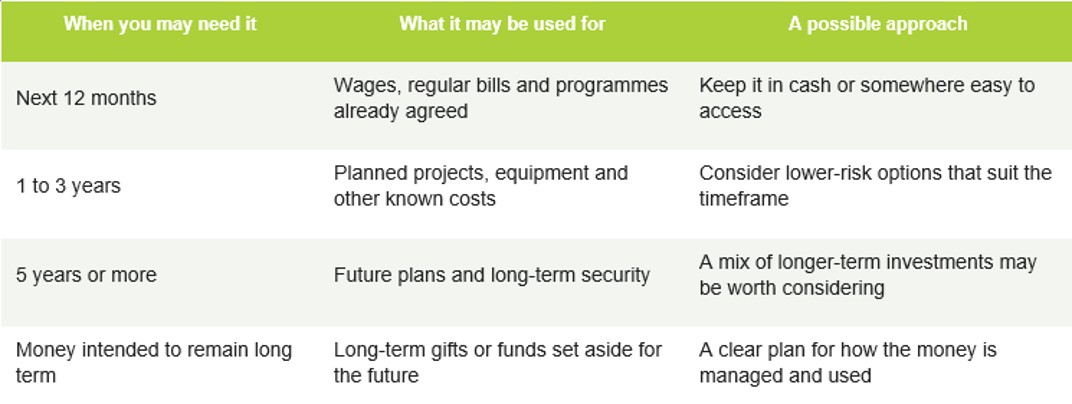
A simple first step is to group your money by when you may need it:
Start with your organisation’s needs and future plans. Do not start by chasing the highest return.
Work out how financially prepared you are
Before discussing investments, the board should understand how well the organisation could cope if funding changed. Ask:
A useful question
How many months could we continue operating if a major funding source disappeared tomorrow?
The answer will help the board work out:
· the minimum level of reserves the organisation should protect
· how much cash needs to remain immediately available
· which funds are committed or restricted
· whether any money is unlikely to be needed for several years
· how quickly costs could be reduced if funding changed
This step is important because it links the money in the bank to the real risks your organisation faces.
Give every part of your reserves a job
Many organisations build up reserves through careful spending, a good funding year or a one-off gift. The bank balance grows, but the board may not have agreed why the money is being kept or what it will be used for.
A simple reserves plan could separate money for:
· regular bills when funding arrives at a different time from expenses
· unexpected costs or a sudden loss of funding
· programmes or projects already agreed
· replacing equipment or maintaining property
· growth, new services or future opportunities
· money intended to support the organisation well into the future
Practical insight
If the board cannot clearly explain why money is being kept, when it may be used and who can approve spending it, it may be time to update the reserves plan.
Could some long-term money help fund your future work?
If your organisation has money it is unlikely to need for several years, some of it may be able to help fund your work in the future instead of all remaining in cash.
A well-planned approach may help your organisation:
· keep up with rising costs overtime
· earn another source of income
· reduce pressure on fundraising and grant applications
· cope better during difficult funding periods
· support future programmes, buildings or opportunities
This is not about turning your organisation into an investment business. It is about making thoughtful choices so your money continues to support your purpose.
Not every dollar needs the same plan
For example, an organisation with $3 million in reserves might decide:
· $750,000 may be needed within the next 12 months
· $750,000 may be needed over the following two to three years
· $1.5 million is unlikely to be needed for at least five years
Each amount may need a different plan. The short-term money could stay in cash. The money needed in two or three years may suit a lower-risk option. The long-term money may be able to accept some ups and downs in return for the chance to grow over time.
The main point
This is not simply about deciding whether to invest. It is about managing each part of your reserves based on when it will be needed and what it is for.
Make sure the board has a clear plan
Before changing where money is held, the board should agree and write down:
· the purpose of each reserve
· how much money must remain easy to access
· expected timeframes for using the funds
· how comfortable the board is with the value going up and down
· any investments the organisation does not want to support
· who can make decisions and how much they can approve
· who will provide advice and manage the funds
· how results, risks and fees will be checked
· how often the policy and strategy will be reviewed
A written reserves and investment plan makes responsibilities clear. It also helps future board members understand what was decided and why.
Simple questions for your next board meeting
· How much cash do we really need over the next 12 months?
· Is any of the money required to be used for a specific purpose?
· How many months of normal costs should we keep in reserve?
· What would happen if our largest funding source ended?
· Do we have a realistic cashflow plan for the next 12 to 24 months?
· Are any funds unlikely to be required for at least five years?
· Is inflation reducing the real value of our reserves?
· Do our reserves and investment plans still fit what we are trying to achieve?
· Is it clear who makes decisions, what reporting is needed and when the plan will be reviewed?
· Do we need financial, legal or investment advice before making a decision?
What to do next
The right answer will be different for every organisation. Keeping all reserves in cash may be right for some. Others may find they have money that will not be needed for many years and could be managed differently.
What matters is that the board makes a clear, informed decision that supports the organisation’s purpose and future plans.
How TAEL can help
TAEL can help your board work out how much money to keep in reserve, prepare a cashflow plan, consider what could happen if funding changes, and put a clear reserves plan in writing. If you need investment advice, we can work alongside an appropriately qualified adviser.
The key message
Money needed tomorrow should be easy to access. Money needed in two years should be managed with that timeframe in mind. Money that may not be needed for five, ten or twenty years deserves a different conversation.
For organisations with significant reserves, a clear plan may help the money keep pace with rising costs, provide more security and support future services.
Investing involves risk, but leaving too much money in cash for too long also has a downside. The value may not fall on the bank statement, but the money may buy less over time.
Important information
This article provides general information only. It is not financial or investment advice for your organisation. Every organisation has different goals, cash needs, rules and comfort with risk. Investments can go up or down, returns are not guaranteed, and access to money depends on the investment chosen. Please obtain appropriate financial, legal, accounting and investment advice before making decisions.
Not-for-Profit Advisory
Ready to strengthen your business? Let’s work together. Schedule your no-cost initial Prospective Client Meeting (PCM) to see what’s possible.
